5 Takeaways from the 2026 NeoCon Talks

NeoCon is not for the faint of heart. This year’s attendees visiting The MART—a building in downtown Chicago so enormous that it used to sport its own zip code—managed appointment-filled days and accumulated impressive step counts. With over 450 exhibitors as well as attendees from 88 countries, the programming for this 57th edition was jam-packed with activations: Sandow’s DesignScene, comprising METROPOLIS’ Sustainability Lab, the Designer Wellness Lounge by Design Milk, and an interactive experience by Interior Design; the new Illuminate lighting show; and more. One misstep could take you from a brand showcase to a showroom dance party!

Acoustical trees courtesy of Slalom.

Dais Chair by Keilhauer.
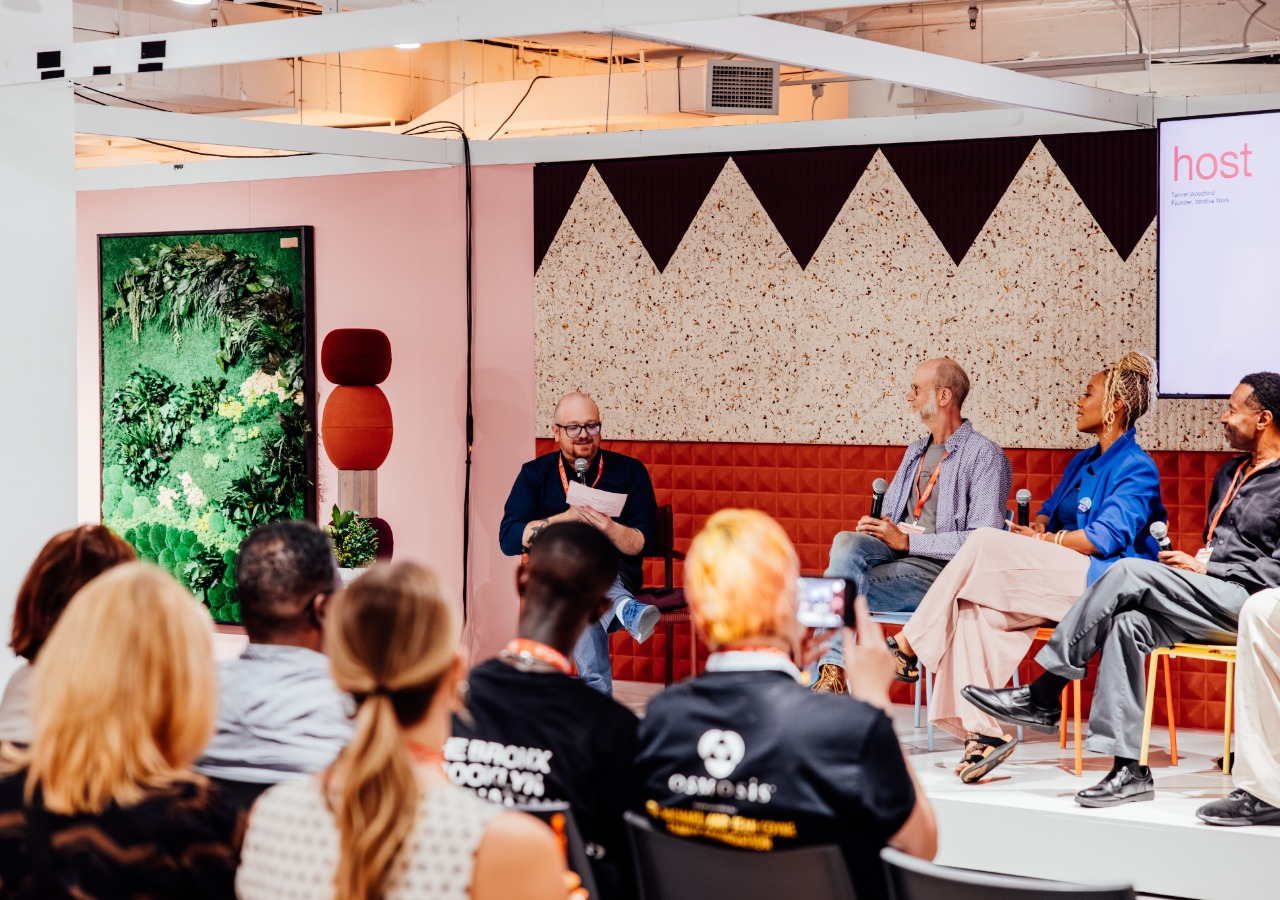
That mixture of excitement and engagement spilled onto The Mart’s 7th Floor Exhibit Hall, where audiences gathered for the 2026 NeoCon Talks. Presented in partnership with Design Milk and sponsored by Slalom Acoustic Solutions, MOCKETT, Garden on the Wall, Andreu World and Keilhauer, this two-day talk series—hosted by Assistant Editor Sophie Sobol—featured a diverse range of design-forward dialogues. With over a dozen compelling speakers presenting on a variety of important topics, which included designing for neurodiversity and salutogenic interiors, the 2026 NeoCon Talks left attendees with plenty of insightful perspectives.
Below, explore five of our top takeaways…

Acoustic totems & stage design by Slalom.

Brezal chair and table by Andreu World. Architectural hardware support via MOCKETT.

Preserved Plant Walls courtesy Garden On The Wall.
1. The Invisibility of Disability
Kristin Cerutti, Regional Design Leader, Workplace at NELSON Worldwide, began her talk with a simple yet powerful framework. “There are two types of people: those who are who are disabled and those who are temporarily abled,” she explained. That’s why designing for all types of abilities is so important—especially when disabilities are invisible. According to Cerutti, 1 in 6 people globally have a disability, and around 80 percent of those are invisible. In response, Cerutti advises designers to be curious and compassionate, look for an opening, and do their own research because, as she says, “the more we talk about it, the more visible we become.”

2. Sound and Color Are Not Competing Systems
Elettra de Pellegrin understands the profound connection between sound and color. In her NeoCon Talk, the founder and CEO of Slalom Acoustic Solutions walked listeners through the psychology behind colorful architectural acoustics and how different elements work together to improve wellness—affecting stress reduction, concentration, productivity, emotional well-being, comfort perception, and spatial experience. Acoustical trees and colorful pink totems from Slalom surrounded the NeoCon Talks stage, proving their material’s fitness for purpose with style while imbuing the space with a playful sense of joy.

3. Are You Solving for the Whole Self?
For Jill Stewart, President of Office Revolution, and Kelly Colón, Coach, Educator, Author and Founder of Eledex Consulting, inclusive design is more than physical mobility or sensory accessibility—it must include the whole body’s integrated biological systems. Enter: Whole-Body Design, a framework that recognizes humans as complete organisms, uniting sensory, cognitive, and psychological systems. “The more we understand people, the better we can design environments that support the whole self,” the duo explained.

4. Designing for Neurodiversity: Space Doesn’t Equal Safety
Arnold C. Levin, Principal of strategic design firm CWI, has learned profound lessons from his daughter, Zoe, on how her neurodiversity affects life in the workplace. But one key takeaway? Space alone is not a solution. In open-concept offices intended to be inclusive, many neurodiverse folks struggle to feel safe, often distracted by sounds, layouts, and other triggers. In this talk, Levin challenged current assumptions about designing for neurodiversity in the workplace, asking: have we been solving the wrong problem really well?

5. Circularity Fails When Projects Are Still Designed to be Linear
In this talk, Brittany McNairy, Senior Technical Coordinator and Senior Associate at Perkins&Will, and Timothy Anscombe-Bell, Fitwel Ambassador, ASID Director, Sustainable Design Collective, honed in on the barriers to circular interior design and delivery—and what can be done to overcome them. For McNairy and Anscombe-Bell, connectivity is key, but so are practical tips for success. Here’s their list for what can be done in the immediate future: 1) start reuse efforts and align project partners early, 2) inventory existing spaces before demolition, 3) include reuse design intent on drawing, 4) start small with one project component and 5) ask manufacturers about their take-back programs.
View the full 2026 NeoCon Talks recordings at neocon.com
2026 NeoCon Talks sponsored by Slalom Acoustic Systems, Garden on the Wall, MOCKETT, Andreu World, Keilhauer.
Photography by Kevin Serna.